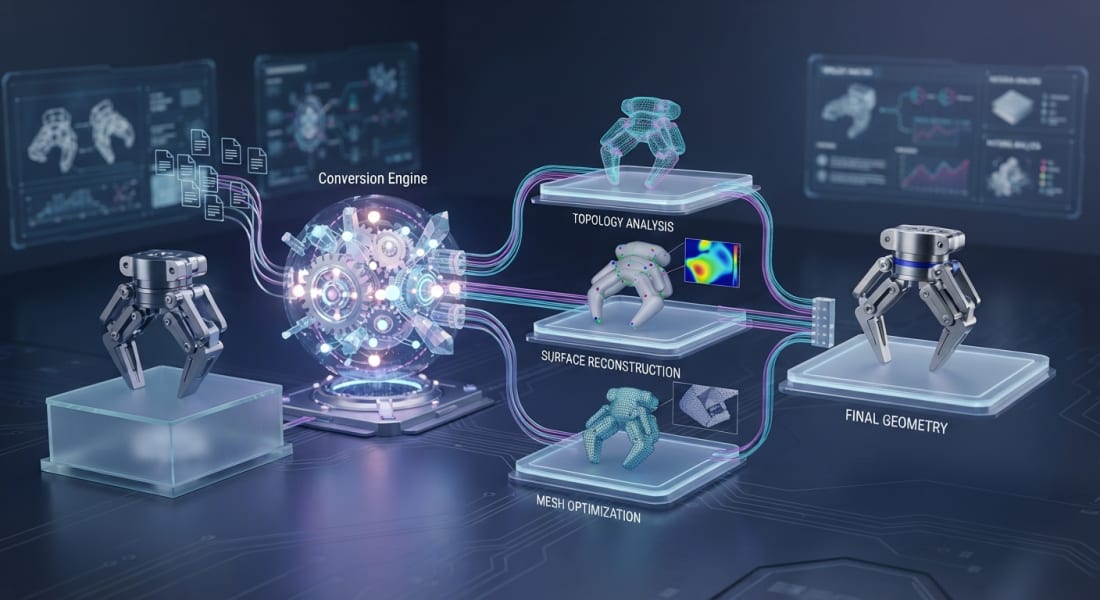
Selecting the right geometric foundation is an important decision when developing software for CAD, CAM, CAE, visualization, or other 3D engineering applications. A geometric kernel provides core capabilities for representing and manipulating shapes, making it possible for developers to build sophisticated modeling workflows without implementing every geometric algorithm independently.
The choice can influence model accuracy, performance, scalability, and the overall development process. Rather than focusing only on the number of available features, development teams should evaluate how well the technology matches their application's requirements and how effectively it performs with realistic engineering data.
Define the Application Requirements
The first step is to understand what the software needs to accomplish. A mechanical CAD application may require advanced solid and surface modeling, while a technical viewer may place greater emphasis on visualization and fast model loading.
Other applications may require geometry analysis, model preparation, data conversion, measurement, or integration with manufacturing and simulation systems.
A clear requirements list helps developers identify the capabilities that are essential and avoid selecting technology based on features that will not be used.
Evaluate Modeling Capabilities
A kernel should provide the geometric operations required by the target application. Developers may need support for solids, surfaces, curves, edges, and wireframe entities.
Solid modeling can include operations such as Boolean combinations, transformations, and feature-related modifications. Surface capabilities may be important for products with complex curved forms, while curve and wireframe functions can support specialized modeling workflows.
Testing these capabilities with representative models provides more useful information than relying only on demonstrations.
Consider Accuracy and Robustness
Engineering models often contain complex intersections, small features, curved surfaces, and detailed boundaries. The geometric foundation needs to handle these conditions consistently.
Developers should test difficult models and repeated editing operations to evaluate how reliably the technology produces expected results. Robust behavior is particularly important when models will be used in manufacturing, simulation, inspection, or other downstream processes.
Validation should be part of the evaluation process so that potential geometric issues can be identified early.
Examine Performance and Scalability
A kernel may perform well with individual parts but behave differently when processing large assemblies or complex models. Performance should therefore be evaluated under realistic workloads.
Teams can measure processing time, memory consumption, model loading, and the speed of common geometric operations. These tests can reveal whether the technology is appropriate for the expected size and complexity of production data.
Scalability is especially important for applications that may grow over time as users work with increasingly detailed models.
Review Integration Requirements
A geometric foundation rarely operates alone. Engineering applications may combine modeling with visualization, file conversion, measurement, data management, or application-specific analysis.
Developers should consider how easily the kernel integrates with the rest of the software architecture. Compatibility with the chosen development environment and deployment strategy can also affect implementation effort.
A modular architecture can make it easier to connect geometric functionality with other application layers and maintain those connections over time.
Consider Data Exchange
Engineering teams often work across multiple software platforms. CAD models may need to move between design, manufacturing, simulation, and supplier environments.
Although file translation may be handled by separate components, developers should consider how the geometric foundation interacts with imported and exported models. The ability to work reliably with translated geometry can be important for applications operating in multi-system workflows.
Representative files should be tested to determine whether the expected geometry and relevant model information remain usable.
Assess Development and Maintenance Needs
Long-term software development requires more than initial functionality. Documentation, testing requirements, architecture, deployment, and ongoing maintenance can all affect the success of an application.
Developers should consider how easily the chosen technology can be incorporated into their development process and whether the architecture allows future expansion.
A suitable foundation should support the application's current requirements while leaving room for additional functionality as user needs evolve.
Test Before Committing
A practical evaluation is one of the most effective ways to choose geometric technology. Development teams can create a test set containing simple parts, complex surfaces, large assemblies, and models representative of actual customer workflows.
The evaluation can cover accuracy, robustness, processing speed, memory usage, integration, and data exchange. Results from realistic testing can provide a clearer basis for architectural decisions.
Building on the Right Foundation
Choosing a geometric kernel is a significant technical decision for teams developing professional 3D engineering software. Modeling capabilities, accuracy, robustness, performance, scalability, integration, and long-term maintenance should all be considered together.
By defining clear requirements and testing candidate technology with realistic engineering data, developers can establish a solid foundation for their applications. The right geometric foundation can then support specialized workflows while allowing development teams to focus their effort on the features and experiences that make their engineering software useful to its intended users. 3D Engineering Software Components for Modern Applications
#C3DConverter #STEP #CADDataExchange